A different creative project each week…from children's parties to sewing curtains

Monday, 24 June 2013

Decoupage

This is a project I have made in the past on mass for Christmas presents or birthday presents. I have discovered a fabulous company called Infinite Store who create a wide range of wooden letter, shapes and objects at very reasonable costs, and to the specification that you want. Letters start from 35p.


You will need:

A wooden letter or shape (see above)
Decoupage Paper (which can be bought from any good craft shop)
PVA Glue (or Mod Podge)
Frame
Card


Begin by covering an area of the wooden shape with a layer of glue. Tear your paper into small squares and lay a small piece down at a time. After each piece is laid down apply a layer of glue on top.

You can see from this photo that I have layered up the decoupage paper, sometimes with only one layer and sometimes with more. It is hard to imagine that the higgledy-piggledy nature will look as good as the pice of paper itself, and yet it creates a fun and creative look once complete.

It is important that you constantly layer the paper with glue. Each piece of decoupage paper must be put onto a surface covered with glue and then have glue added to it.

The final layer of glue acts as a varnish.

You can see from this photo that I haven't glued the sides of the letter and so the paper overlaps across the sides.

At this stage you can leave it to dry overnight.


Once the glue has dried turn the letter over and cut around the shape with a sharp pen-knife or scissors removing it of all the extra paper.
I found a brightly coloured piece of card which compliments the decoupage paper. I cut the paper to the size of the frame using the glass as a template.

Then, using double-sided tape (or a layer of glue) I stuck the finished letter to the card.


This box frame from Ikea was £3.50 and is ideal.

The finished frame is perfect for children's bedrooms, gifts for new babies, or you could just do the letters and make up words to decorate your home with.

This takes minutes to complete and is a very easy project. My children enjoy decoupage and although the paper can seem expensive it goes such a long way that it really isn't an expensive past-time.

This finished frame cost no more than £5 to make and 10 minutes in time (not including drying).

Monday, 17 June 2013

Edible gifts

With the end of the school year looming I have counted 13 presents that I will need to get for the teachers of my children to congratulate them for surviving a year with one of my kids in their class!

Seriously though, this is no small cost! So several years ago I decided to make presents for the teachers at a fraction of the cost of bought ones, and each year they are greeted with sincere delight and thanks. Here are some ideas and recipes of home-made edible gifts…


Firstly, a very easy, but terribly delicious bar of chocolate. Hotel Chocolate do a similar chocolate bar for £15, so already we are saving a fortune!

Melt a large block of good quality chocolate. I used Dairy Milk, and poured it into a square tin that has been lined with baking paper. Make sure the chocolate is at least 8mm thick. Bang the tin against a hard surface so the air bubbles in the chocolate rise to the top and burst. You may need to do this a few times.


Now melt two or three pieces of white chocolate and drizzle it over the chocolate. I want to make two bars from my chocolate, so I have left a gap down the middle where I will cut it later. Now use a knife tip to pull the white chocolate in swirls to create a marble effect.


Whilst the chocolate is still warm add chunks of fudge or any other topping (dried fruit, marshmallows, sweets etc). Leave to dry in room temperature for about 1 hour, and then slide a knife around the edge and cut into the bars you want.

It will take several more hours to dry completely.

When totally dried, peel away from the baking paper and cover with cellophane and add a ribbon.

Cellophane can be bought at craft shops or florists. I always think it is worth being lavish with your cellophane as it gives the appearance of grandeur!
I made up a batch of Flap Jack and have shown you two ways to package these little morsels into gifts. You can use this recipe or use the wrapping idea for any other tray-bake (millionaire shortbread, brownies, cookies etc).

250g Butter
250g Golden Syrup
250g Sugar
500g Oats

Over a low heat melt the butter, syrup and sugar until completely melted. Add the oats, mix thoroughly and add to a tin. Cook in a 180 degree oven until almost cooked (abut 25 minutes). The middle should still be soft. Remove and let it cool. Flap Jacks will continue to cook once removed from the oven, so don't over do them!

I made this tray-bake, but had enough mixture to fill a mini muffin tin with rest. I find these little muffin cases great for children's sized bites.

Now for the wrapping:

This small jar is from Ikea for £1. It is such a lovely way to present food like biscuits or these little flap jacks. With a ribbon and a flower they are sweet gift for anyone.


And for the larger pieces of Flap Jack, or any other slice of tray bake, use a long piece of cellophane and a small square of cardboard as a base to wrap them up.

This only has 5 pieces of Flap Jack in but makes a lovely present for a friend.


I have come across a beautiful range of baking boxes from a company called Kitchen Craft. This pretty baking case is made from silicone coated card and allows you to bake your cake in it.

It kept its shape as I cooked my chocolate cake and once iced, covered in cellophane and decorated with a ribbon and a tag (which I added buttons to), creates a scrummy present for someones birthday.


And the final present is fudge using James Martins recipe.

I used this little wooden box that I bought for a couple of pounds in Hobby craft. I had previously had aspirations to decorate or decoupage the box, but now simply lined the bottom of each section with some tissue paper and placed the fudge on the top. Tissue paper looks pretty but also has the benefit of filling space if you haven't made quite enough fudge! You could do this with homemade truffles or sweets.

It certainly takes longer to make presents than buy them, but it so thoughtful to spend the time making a present, and in wrapping your gift beautifully you are taking pride in what you have done.

Monday, 10 June 2013

Country Bunting


With summer on our doorsteps I wanted to brighten up our garden with some summer colour. Bunting is an immediate way to create a summery party-feel to your home or garden, and whilst it is relatively easy to make it is always expensive when bought in the shops.

This project is a really fun first time project if you have your granny's sewing machine in the loft and haven't used it before.. You have little room to go wrong, but a warning that it is quite a time consuming project.


Firstly I cut up my cardboard template. Lots of bunting is based around the triangle shape, but I wanted to try something different, so I used a small plate and cut off a third of it. This then formed my template.

You could use one type of fabric, or like me you could mix up your patterns and fabrics, which is a great way to use up all your left-over pieces of fabric.
Fold your fabric in half and lay the template on the fabric. I used a pen to draw around the template and then carefully cut out through both layers of fabric.

If you find the fabric slips when you cut it out then pin it together first.
Once you are content with the numbers you have cut out you are ready to start sewing!

Place pairs of material together with the pattern facing each other as shown in the photo.
Pin the two shapes together around the curve and then sew around the edge of the circle approximately 1cm from the edge.

This is the only bit you will be sewing as you need the straight edge left open to turn it all out.

To make 15 meters of bunting I made 25 circular shapes. This will obviously depend on how big your shapes are and how closely you are to place them on the ribbon later.
Now you have sewed all your circles you are ready to turn them the right way around.

My tip for making sure they are as neat as possible is to cut a 1cm edge off the cardboard template, then insert it into the fabric and press the fabric with an iron before removing the cardboard.

This will ensure that the fabric bunting is beautifully turned out. I am not one for ironing at the best of times, but in this instance it is worth it.

Now for the finishing touches…

Using tape from a haberdashery begin to place your bunting along.

The tape is going to act like a hem covering over the top of each of your circle.

Lay the bunting on the bottom half of the tape, then fold it tightly over the top of the circular shape

Before sewing measure the distance you want between your circles and pin each one to the tape. It is sensible to leave a meter of tape at each of the ends. This will leave you some tape to tie up your bunting when finished.

It is worth getting the spacing accurate because it is hard to rectify after you have begun sewing.

Now start at one end of the tape and carefully use your machine to sew from one end to the other in one long seam.

It will take time and you will have to be careful to make sure that each of the circular shapes is fully caught in the tape before you sew it, but it is extremely satisfying and if you have done your work until this point you will end up with a fantastic result.

The principles of this technique can be applied to make most shaped bunting, but I think shape is so pretty and it is certainly easier than triangular bunting!


Monday, 3 June 2013

Little girls hairstyles

I have two lovely girls: Jessie who is 8 and Molly who is 6. I normally insist that their hair is platted for school each day to limit the chance of nits, and because they look very cute! This week my creative challenge was to put their hair into a different style each day.

As you can imagine trying to get four children out of the house to school in the morning is not aways  a relaxed affair,  so these ideas are measured for time and complexity.


Day 1:

I saw a picture of this hairstyle and loved it immediately. I am not sure if I have done it right, but I love the result. I divided Jessie's hair into three sections on the top and loosely tied them into hair bands. Then I made a hole through the top section of hair and pushed the hairband and each little ponnytale through the hole until it rested back on her head.

This would be a great hairstyle for any girl with shorter hair too.


Difficulty:  Easy
Time: 2 minutes
Results: Still in at school pick up time!


Day 2:

This hairstyle assumes you know how to do a french plait. If not then you may want to practice doing it straight down the head first until you feel confident to do it on the side. Watch this link for a French Plait tutorial.

I plaited Molly's hair from right to left and gathered all the final hair into a ponytail on the side.

Then I twisted the ponytail into a knot and added a flower clip to pretty it up!

Difficulty:  Moderate/Difficult
Time: 6 minutes
Results: Still in at school pick up time!


Day 3: 

Here is Jessie with her hair split into four (parting down the middle and then from the top of each ear).

I put the top sections up and then crossed the small ponytails and scooped up the rest of the hair into the bottom ponytails.

I have to confess I did need her help to hold the bottom ponytails at some point.

Difficulty:  Moderate
Time: 4 minutes
Result: Still in (but not as neat) at school pick up time.

Day 4: 

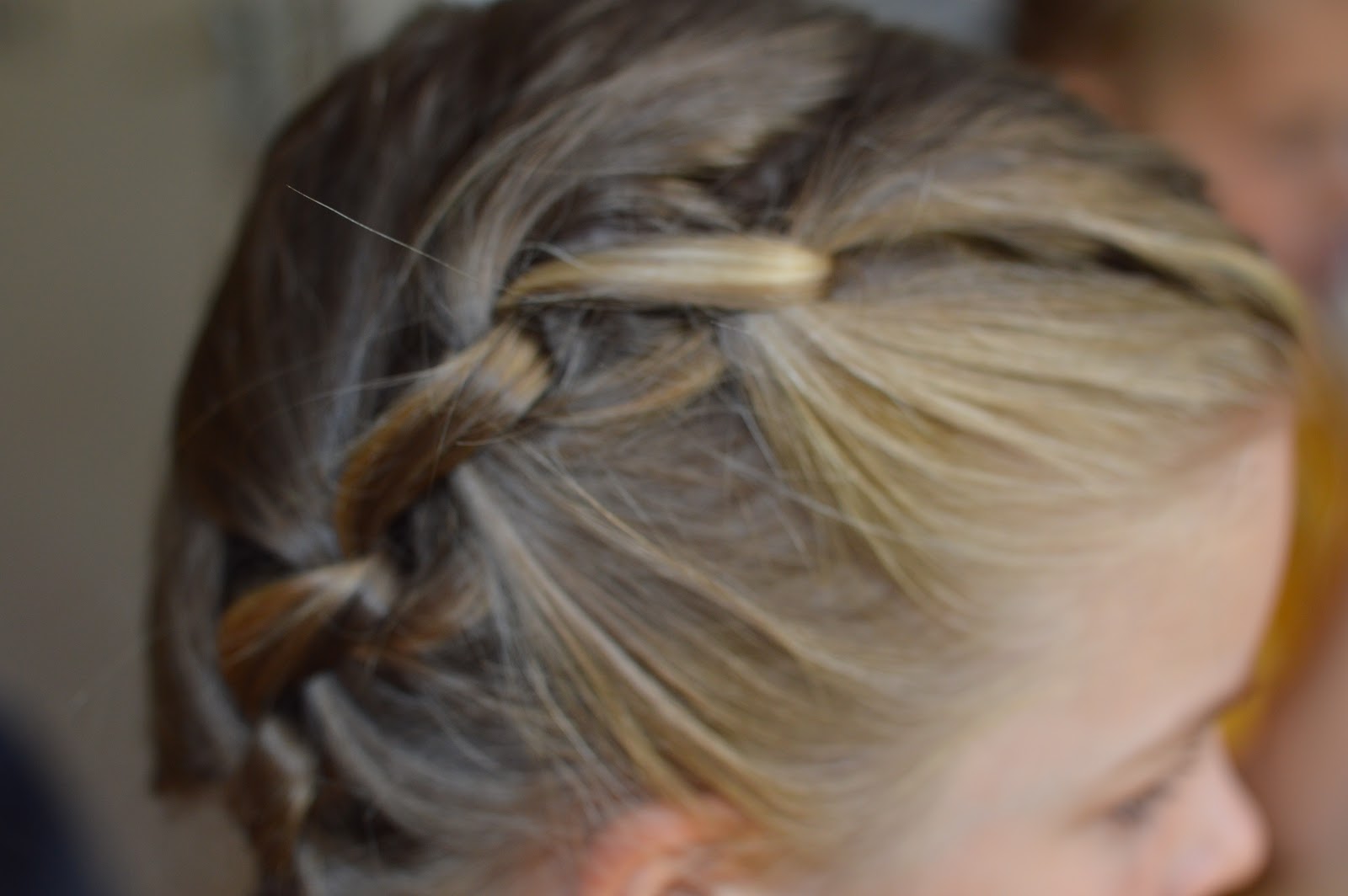
This is a French Plait along the top of the head but only introduces hair from the face side. I have found it looks much prettier than a normal French Plait hairband look because the plait doesn't get too thick.

You could either pin the plait behind the ear to wear the hair down, or you could tie all the hair into a side ponytail.

Difficulty: Moderate
Time: 4 minutes
Result: Very loose at school pick up time

 Day 5:

This is the most difficult of this weeks styles. It needs practice.

Divide the hair into two, like bunches but only tie one side up. On the other side gather the front section of hair and split into two. Knot the hair as if you are tying a shoe lace. Pull tight.

Now add a new section (like you do with a French Plait) to each of the two sections you already have, and knot again. Pull tight and repeat until you are satisfied with it. Then gather all the hair that is left on this side of the head and tie in a hairband.

Repeat on the other side of the head.

Difficulty:  Complicated but easier once you have the knack!
Time: 8 minutes
Results: Still in at school pick up, but wouldn't be if her hair was much shorter.


Day 6:

My husband has offered to do today's hair…watch and learn!


Saturday, 25 May 2013

5 Mod Podge Projects

Mod Podge is the American's answer to PVA glue. It can be bought at Hobbycraft and costs £7 for a medium jar. I bought it to see the difference and really do like it when needing something slightly more robust than regular PVA glue.

Here are five projects for you to try, the first of which could easily use PVA glue instead!


I absolutely LOVE a beautiful book or journal that I can write in. I think it is one of life's little pleasures, and here I am showing you how to transform a cheap notebook from a PoundShop into something delectable!

You will need a hardback book and enough fabric to cover it. Iron the fabric to create a really smooth look. (I am no ironer but it really is important on this project!)

Spread the Mod Podge sparingly over only one side of the book. If you do all sides at the same time you will get sticky and your book will not get the same high finish. It is important not to put too much glue on. You don't want it bleeding through the fabric.
Make sure the fabric pattern is facing the table when you lay it out and then gently lay the glued side of the book down onto the fabric leaving a margin around the book.

Now apply glue to the spine of the book and roll the book over onto the fabric. It is tempting to lift the fabric onto the book, but trust me, you will get a much neater finish if you do it this way. If you have ridges in your spine, like I do, then gently use your finger to stroke the material into the ridges. But do this after you have rolled it over.
Repeat this on the final cover of the book and then leave to dry.

Once it has dried (1/2 hour) cut triangles into the margins. If you need to make the margins straighter then now is the time.


Glue the margins into the front and back of your book. If your fabric is very light you may need to wait until the glue is dried on the front before doing the back or you may find the pages stick to the fabric.

I do find that Mod Podge stiffens the fabric so you don't need to worry about fraying edges. If you use PVA glue and you find the edges are fraying you may want to get piece of card to stick over the top of the margins covering the entire inside covers of the book.
Finally you can see the inside of the spine. You should have a piece of fabric left to glue. Don't be tempted to cut it off. The longer this is the easier you will find it to stick. Apply a small amount of glue and then whilst holding the pages of the book allow the front and back cover the bend backwards opening the hole behind the pages.


Now with a scissors or a pen insert the fabric as deep into the hole as you can manage.

Here are two finished books. I am so pleased with how they look. I finished it off with a felt flower and a button that I stuck on with Mod Podge.

These took 10 minutes to make (plus drying time).
I bought these little wooden disks ages ago and have wondered what to do with them.

Very simply I covered them with a light layer of glue and stuck them onto some pretty wrapping up paper.

Once they were dry and turned it over cut around the paper using the disk as my guide and then glued over the top of the paper to create a varnished look.
Once dried I applied Mod Podge to these brooch backs from HobbyCraft  (£1 for 4) and stuck them onto the back of the disks to make pretty badges.

My children are delighted to use them to jazz up plain t-shirts and coats, and I was even thinking I could make boys badges out of magazine cuttings of their football club…watch this space!


These coasters from Wilkinsons were £2 for four. I have used the same technique, as mentioned above, to add my own flavour to them.


Add glue to the coaster then stick onto the fabric. Trim the fabric once dry and reply glue to the top of the fabric which will add a varnished feel.
This vase was an experiment and whilst PVA glue would work on most of the above projects I'm not sure it would have been suitable for this one.

I loved the little shape of this glass drink bottle and so I came up with the idea of covering it with a pretty off cut of fabric.


Firstly I glued the jar, then quickly wrapped the fabric around it.

I used a slightly stretchy fabric which helped in moulding it around the neck of the bottle. Once in place I was able to trim the fabric to join and overlap a little (see below) and then glue the bottom of the fabric underneath the bottle.

I made sure there was enough fabric on the top to glue it inside so that it looks like the fabric covers the inside too. I did this by gluing the neck of the bottle and folding the fabric into it.

Alternatively you could just trim it around the bottle top.

End your project by putting another layer of glue over the bottle. I found this easiest using my fingers which allowed for a much smoother finish. As you can see from the photo above the finished bottle looks bright and cheerful and the fabric has set so hard that it is incredibly durable.


And finally I used Mod Podge to decorate this little stool. We have had it since our first child Billy was born and use it all the time. But since he goes by the name Billy rather than William he has little ownership over the stool…so I nabbed it!


Someone has pointed out that this stool would look even cuter if I had painted it in chalk paint before hand. For more information on Chalk Paint see here.


I measured the circular top by using a plate which I then drew around onto the fabric I wanted to use.

Cut it out with a sharp pair of scissors and trim around so you don't have any stray lengths of cotton.
Now add glue to the stool, lay your cotton circle on and then cover the fabric in glue to seal.

Unfortunately I didn't take a final picture of this but it has worked well. And if you want to change the finished look in the future you can simply add a different layer of fabric to the top.

I hope you enjoy gluing as much as I have!!!