A different creative project each week…from children's parties to sewing curtains

Sunday, 15 September 2013

Needle Felted Angel


This week I have had the enormous treat of learning a new skill with my dear friend Rachel.

She taught me the amazing art of needle-felting and here is how I made this adorable angel from nothing other than felt, a felting needle and a foam pad.

If you have never practiced the art of needle felting then I urge you to immediately. It is cheap and so satisfying!

Here is a photo of the basic equipment you need to make this lovely angel. Felt in the right colours, a felt needle and a foam pad. These were bought from 'Mother Hubbard' in Nailsworth, who have a wonderful selection of wools and felts. Alternatively Ebay have a large selection of felts.

Begin by rolling a section of felt into a round shape similar size to a ping-pong ball. Roll as tightly as you can.
Place the ball onto the foam and stab the felt needle into the ball of felt and as you do something miraculous happens. The felting needle has small barbs on the bottom and as you thrust it into the felt it fuses the wool together.

Stab it all over the ball and over the course of ten minutes the ball of felt will turn firm as it blends together. Do make sure you stab it all over the ball which will ensure an even blend.


Once the head is hard you are ready to cover it with the skin coloured wool.

Whenever you use felt you should never use scissors but gentle pull the wool to separate it into the lengths and amounts that you need.

Wrap a small amount of wool around the middle of the section of skin-coloured wool. You should wrap it tightly which will bind it.

Gently splay the wool into a full circle around the tie.

Once you have done this lay it over the top of the ball of wool and stroke the wool over the top. You should ensure the wool covers the ball completely and the tie at the bottom with another small strand of wool.

We are now ready to form the arms. You will need half a pipe- cleaner.  And now begin wrapping the skin-coloured wool around each end. You will need to cover an inch of each end of the pipe-clearner tightly with the felt.


Then fold the end centimetre over and wrap over some more skin-coloured felt to make the hand and bottom of the arm.
You can see from the photo that I have done this to both sides of the arm.

Now to attach the arms to the head. With the arms slightly off centre hold tightly to the neck of the angel and wrap it completely around the neck of the head so you are left with two arms the same length.


Use the skin-coloured felt to wrap over, under and around the
shoulders and arms of your angel. This will build up the body but also hold the arms in place.

Tie a piece of felt around the waist-band
We are ready to begin dressing our angel. Begin with the sleeves by wrapping the colour you want for her dress, blue in my case, from her tummy over her shoulder and then down the opposite arm.


Do the opposite on the other arm so both are now covered.
Add some more blue to the body by going over her shoulders and then use your pin to stab the felt into place.

Remember to stab evenly all over the waist-band on the front and back of the angel.
We are ready to make her skirt. Use a white (or any colour of your choice) piece of felt which is double the length of the skirt you eventually one.

Fold the felt in the middle and hold it in your hand over your finger and gently make a hole large enough for the angel to fit through.


Now gentle sit your angel in the white skirt, pull it down from front and back and shape into the position you want.


Lay your angel onto the foam pad and pin the skirt into place firmly with your felting needle.

Do always be careful when stabbing the needle in. It is extremely sharp and can be painful if your finger gets in the way!
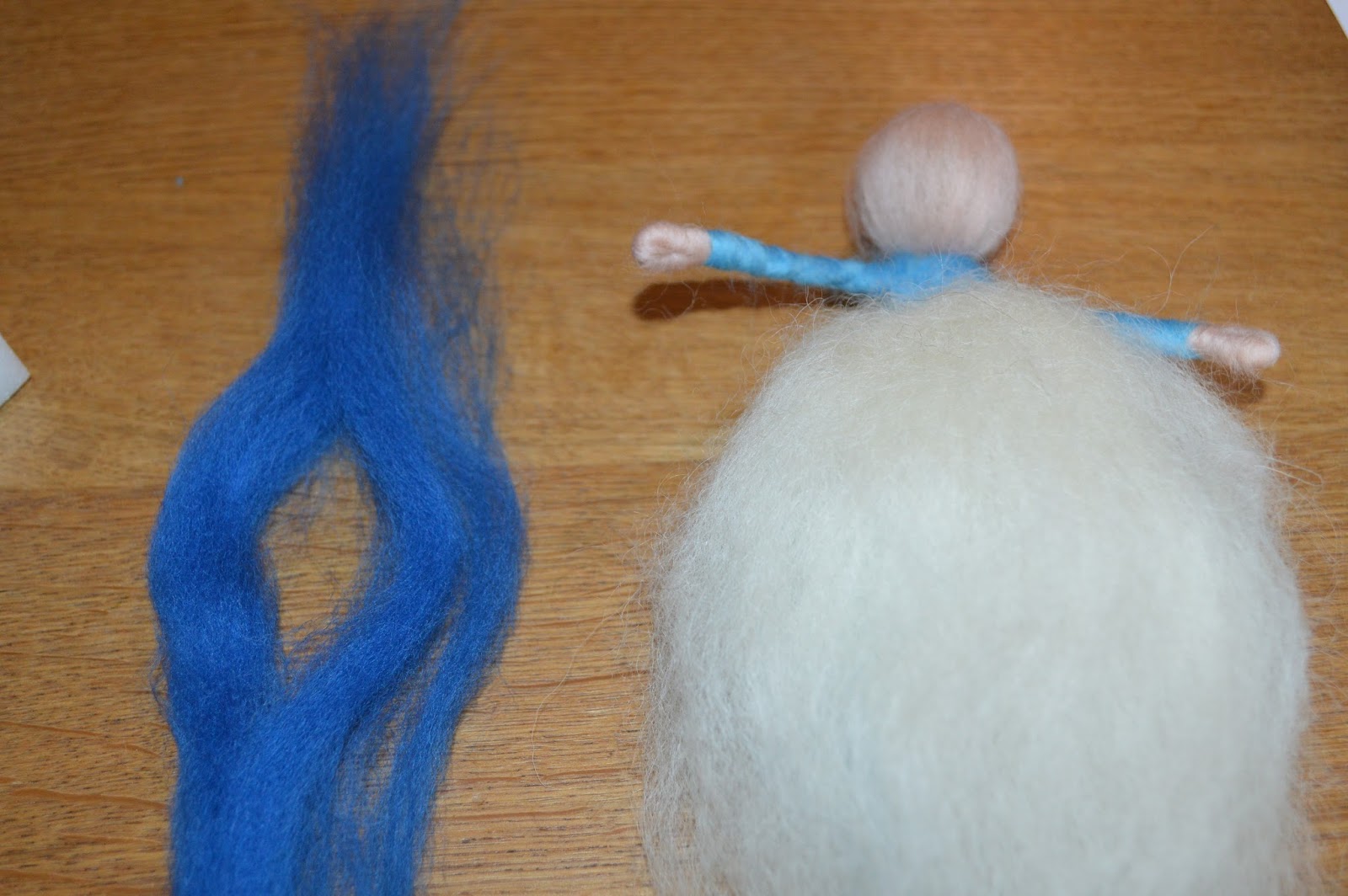
Repeat this process with another colour to make an overlay on the skirt.

This time though the felt will go over head of the angel and rest on her shoulders (demonstrated with the blue felt). You will need less then the white skirt.
Use a small amount of the dark blue to wrap around the angel as a belt.

Unwrap the blue felt gently to create a skirt that overlaps the all around the angel's skirt.

This is my very favourite part.

Choose some lovely felt that will become your angel's hair. Felt that can be used as hair comes in lots of style but this delightful curly felt won my heart.

Use the felting needle to stab it into the ball. It is so satisfying (so long as you don't give too much consideration to stabbing an angel in the head!) to style the hair into a position that you like and know it will stay there.


I have enjoyed every part of this craft, but putting hair onto my little angel has suddenly made me love this little beauty! It has filled her with character.


The wings are next. Use a length of felt and pinch in the middle.
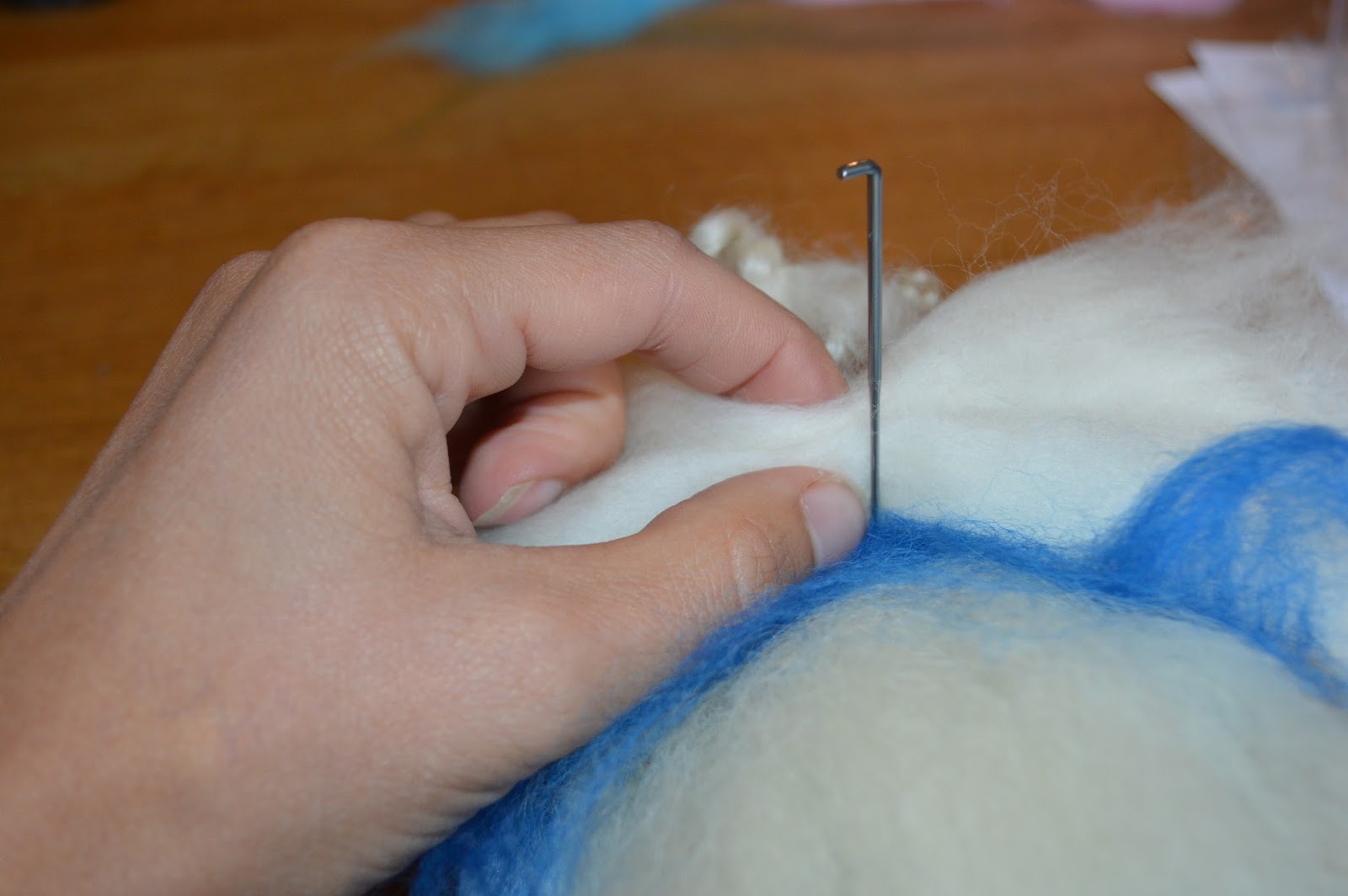

Use the felting needle to pin the back into place. You will need to turn the angel onto her front and lay her on the foam. Stab the wings along the centre into the body. You can see from the photo below how I have pinned it along the central line.


Shape your wings as you please.
Here is the lovely Rachel, who has patiently taught me this amazing new skill. She fabulously artistic and is selling Angels (considerably nicer than mine) for £15. If you are interested in purchasing these then you can email her on rachel@robertsmail.co.uk and I might add that hers come with custom made hair, and lovely things to hold. I ran out of time so currently my angel is empty handed. Do email her for more information or just to say hi!


She is photographed with clear cotton that she threads through the back of the head to the top and then back through the top to the back of the head and knot in place.

This creates a loop on the top to hang your angel.


I have LOVED this project. It has been a completely new skill to learn and such a fun, satisfying and moderately cheap craft.

Thank you, Rachel, for helping make this beautiful craft.


Monday, 9 September 2013

Vintage Hot-Water Bottle Cover

With the cold weather drawing in I am setting about making a hot-water bottle cover for my dear mother-in-law for her birthday this week.

I found this lovely pack of pink vintage fabrics at our village fete that I was determined to make something beautiful out of. The trouble was that each piece of fabric came in awkward lengths and were all different types of fabric, from satin to linen.

So I designed this hot-water bottle cover that showcased all the pretty fabrics and yet wasn't compromised by the differing lengths and weights of fabric.


I began by drawing around my hot-water bottle leaving an inch around the outside.


With each strip of fabric I cut it diagonally making triangle shapes. It doesn't matter if the widths of your triangles vary with this project, so it is a good opportunity to use up all your old scraps of fabric.
Lay two triangles (different fabrics) together with the bottom of the cones together.
Fold one triangle on top of the other with the patterns (or top) of the fabrics facing each other. Pin into place and then sew (hand or machine) down one long length.
Open it out and iron the seams wide. This is the back of the cover so now turn it over and begin again adding on the next triangle in the same way as before.

Carry on until you have enough triangles added to lay your paper template on.


Rotate your fabric around until you are pleased with the position of the paper.

I like having the triangles facing the top right corner, but do use your eye to find what is most pleasing to you.
Pin the paper over the fabric and cut out. You can see from my paper template that I have made a larger neck for the hot-water bottle. This will make it much easier to slip the bottle into the cover.

It is important to cut your fabric at least 2inches wider all around your paper template. This will allow for the water bottle to be filled as well as the seams you will soon sew.

I wanted to add a few pretty details so I found these lovely frills and laces at a local haberdashery shop. Gently pin them into place along a few of the lines between the fabrics.


I cut a piece of heavy cotton (fleece would work equally as well) that I cut out to the same shape as the rest of my cover.

Then I sewed through the lace, the cover and backing along each of the lines where the triangles are joined.  This gave it a light quilting effect.

You can see from this photo that the cotton doesn't even show. I have picked a light pink cotton that surprisingly doesn't even show over the lace let alone detract from it.

The front is now complete!

For the back you need to use the front as a template. Cut your heavy cotton (or fleece) and a light cotton to the same template as the front, but cut the heavy cotton shape four inches shorter at the bottom. Then wrap the light fabric around the bottom of the heavy cotton and sew a seam along this bottom (pictured here on the left) of the two pieces of backing.

The photo here may be confusing as the white fabric you can see is the front, and the red is the hot-water bottle.
To make the bottom of the back you need to use the front section as a template again but only for the bottom third of the shape (see photo).

Again cut your light fabric slightly longer and tuck it around the heave fabric and pin into place.

To finish I am adding a length of lace that I will sew onto the back of the pocket as I sew this seam.

Confused yet???


Once you turn the two back pieces over this is what they should look like...

I have only sewn the mid point on both of these sections.
Now we are ready to essemble the three pieces.

Lay the front section faced up.

Now lay the bottom of the back section facing down onto the front piece.

Finally add the top of the back section facing down onto the two other pieces.

Lay your hot-water bottle on top of the fabrics and pin around the bottle leaving an inch and a half.

I am not one to over pin normally, but in this incident I was keen to mark out exactly where I intended to sew.
Sew around your pins going over the bottom section twice. This will ensure that the opening for your hot-water bottle will not rip when stretched.

Once sewn trim around your cover leaving half an inch around the stitches.


Turn it inside out to reveal a pretty back to your cover...
And an even more beautiful front!


Happy Birthday Sue…I hope it keeps you warm at night!

Monday, 2 September 2013

Clay Decorations


To finish off the 'Crafting with Children' summer series the girls and I have attempted some clay decorations that were actually quite fun and cheap to make. I am sure we will be repeating this activity nearer Christmas!

We used White Air-drying Clay that can be bought from any art shop. A pack is about £5, though if you shop around you can find it cheaper.

The children had to work the clay before it was ready. It didn't take long but you may want to help little children as it is much easier to work with the more you have softened it.


Once the clay is soft mould it into a ball and roll it out using a rolling pin. If you shape it into a ball shape first it is likely to have few, if any, cracks.

We rolled it to 5mm thickness and then lay a piece of cling film over the top.


Now we are ready to cut our shapes. You could just use cutters straight onto the clay, but in putting the cling film onto the clay prior to cutting the shapes will result in beautifully rounded edges.

Gently press the cutter over the film and through the clay.
You can see from this photo how well the cling film works in creating a smooth and well-rounded shape.

Once you have cut out your shape, gently remove the cling film and lift out the clay. You may need to cut the shape out again once the cling film has been removed as the cutter won't always go all the way through. Don't worry, this won't alter the rounded edge, but it is important to get a crisp cut.
If you aren't pleased with your final clay shape then use the back of your nail to smooth out any lines or creases, and if still not pleased just start again!

You can just leave it as it is, or if you want to decorate your clay shape then why not use flowers, leaves, shapes, rubber stamps etc to emboss texture into your piece.

I am using a piece of lavender here, and later you can see that I have used a set of rubber stamping letters to push into a heart with the initial of someone for their birthday.
On this piece of clay we rolled a rolling pin over a leaf pushing the veins of the leaf into the clay which in turn left a beautiful imprint onto the clay.

I didn't want the rolling pin to skew the over all shape of the clay and so I cut around it with a sharp knife after the leaf was embossed.
I have forgotten to take a photo reminding you to put a hole in the clay once you are finished. Use a wooden skewer or knitting needle to push a hole into the clay shape. This will mean you can tie ribbons, string or even key rings through your clay to make them into usable objects. Do make sure the hole isn't too close to the side as the clay may not stand up
Once you have finished your shapes leave them on a baking sheet for 4-7 days. You will need to turn them over once a day to stop them curling.


Here are some of our finished clay hearts. The ribbons have been added for decoration.

They will make lovely little gifts that can either adorn a birthday present, or be a small gift in their own right.

We hope you enjoy making them…